
Today, several open initiatives aim to support agent discovery and interaction, each focusing on different aspects of the agent ecosystem and offering specific strengths and limitations. According to the public documentation of AGNTCY, agents can publish their agent records in an Agent Directory Service and be discovered based on declared attributes, while OASF, in its public materials, defines a reference taxonomy of domains and skills used for the semantic description of agent capabilities. However, this separation of responsibilities leads to a focus on fixed skill schemas and does not provide unified, business goal–oriented discovery: queries are expressed in terms of predefined capabilities rather than expected outcomes. In other words, OASF addresses how agents are described semantically, AGNTCY focuses on their publication and availability within a global ecosystem, while the combination of a semantic model with an operational approach gives these initiatives practical value—a role that the TMF939 Agent Management API aims to fulfil.
According to the public description of the A2A (Agent-to-Agent) protocol, initiated by Google, it defines a standardized mechanism for message exchange between agents across different platforms to enable secure and coordinated agent interaction. Within this approach, the concept of an Agent Card is introduced—a structured JSON description that allows an agent to declare its capabilities and enables others to identify a suitable executor for a given task. At the same time, based on its public positioning, A2A is primarily focused on communication between already known or pre-identified agents and does not define an autonomous Discovery mechanism, assuming that the required agent or its Agent Card is located outside the protocol itself.
Public documentation of agent orchestration frameworks, such as LangGraph (LangChain ecosystem), shows that they provide tools for building complex multi-agent scenarios in which a central router agent classifies incoming requests and forwards them to specialized sub-agents. However, these approaches rely on explicit developer configuration: the set of available agents, their roles, and composition logic are defined in advance at the application level. As a result, there is no transparent, platform-level composition of capabilities, and the combination of multiple agents is typically manual and not visible to end users. In addition, such frameworks do not offer a unified Discovery API that combines attribute-based filtering with semantic search, usually supporting either configuration-driven selection or local routing logic, but rarely both
As a result, several key gaps remain in current Discovery approaches:
- the absence of a unified goal-based query mechanism;
- lack of transparent, automated composition of capabilities across multiple agents;
- weak integration of semantic skill search with traditional attribute-based filtering within a single interface.
Differences of the TMF939 Approach and Addressing Identified Gaps
The MEF.DEV Agent Fabric platform extends the TMF939 Agent Management API proposal based on the specification introduced in the TM Forum Catalyst 2025 project C25.0.798 “Agent Fabric (Phase 2)”, while adding extensions to support a new Discovery approach without breaking standard compatibility. The core TMF939 model remains unchanged and already includes key concepts such as a formal definition of a Goal as an outcome contract for an agent, support for dependencies between capabilities, and classification of agents by autonomy type, including goal-based agents.
MEF.DEV combines these existing TMF939 concepts into a single, practical Discovery approach by introducing targeted extensions such as ExternalId, capabilityKey, DecisionEvidence, and ExpandedContext. Each extension addresses specific limitations—from semantic alignment and federated search to transparent ranking and execution-assisted Discovery—forming a cohesive multi-agent Discovery model on top of the standard TMF939 API.
Execution-assisted Discovery
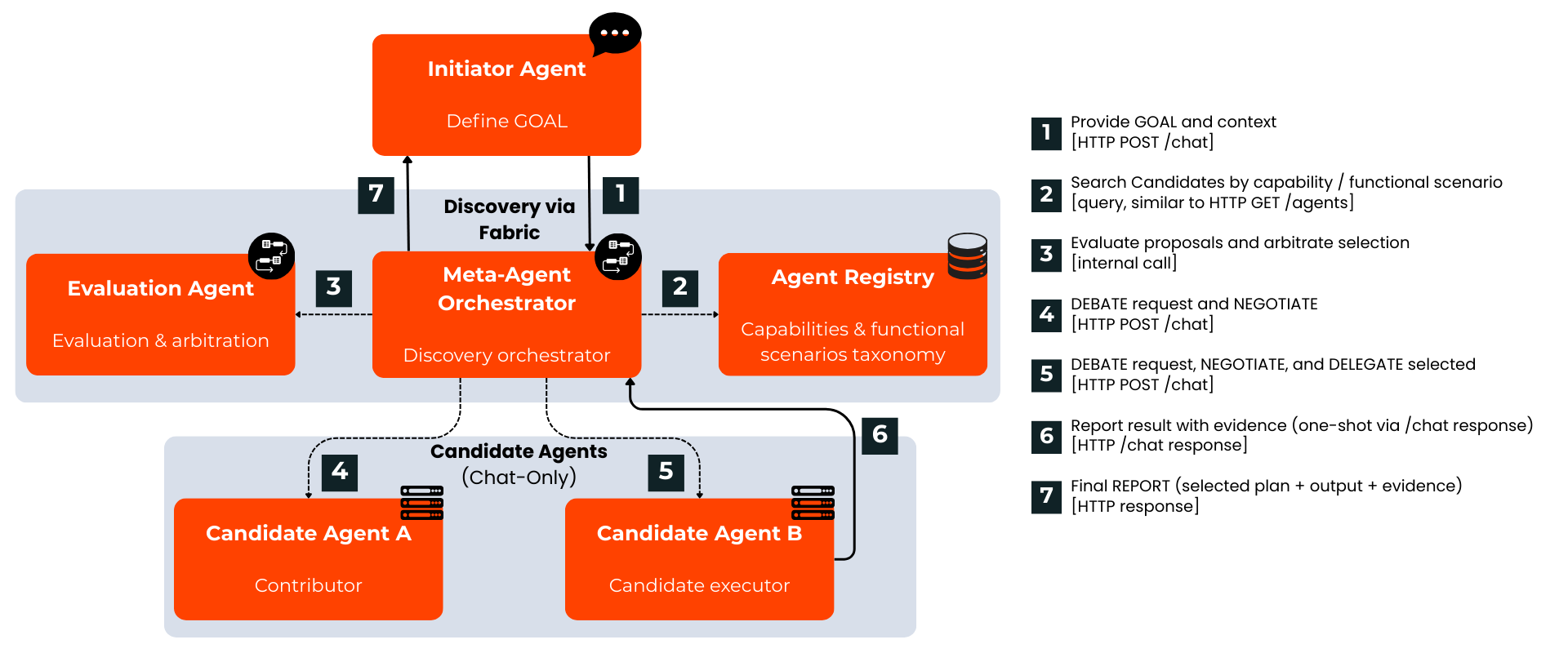
A significant extension from the MEF.DEV perspective is support for an interactive Discovery mode based on agent-to-agent (A2A) interaction, activated for complex or multi-component requests. When achieving a goal requires coordination across multiple capabilities or agents, the platform initiates a multi-agent interaction process in which candidates can exchange proposals, align execution approaches, and decompose the task into sub-tasks with subsequent delegation. When needed, a meta-agent coordinator participates to orchestrate and consolidate alternative solutions. After discussion, alignment, and delegation phases, the selected agent or agent composition proceeds with execution, and the results are aggregated and returned to the initiator as a single, consolidated outcome.
In hybrid Discovery scenarios, results obtained from external directories are normalized into the TMF939 model and integrated with the local agent registry. For such records, an internal agent_id is automatically assigned, capabilities are mapped to corresponding capabilityKey values, and external identifiers are captured via ExternalId, while information about the source (for example, provider: “agntcy”) is stored as part of DecisionEvidence accompanying the Discovery result. As a result, the Discovery consumer receives a single, structurally uniform list of agents, where local and external candidates are treated consistently. This approach removes fragmentation between local and global search and provides a foundation for semantic context enrichment and explainable decision-making.
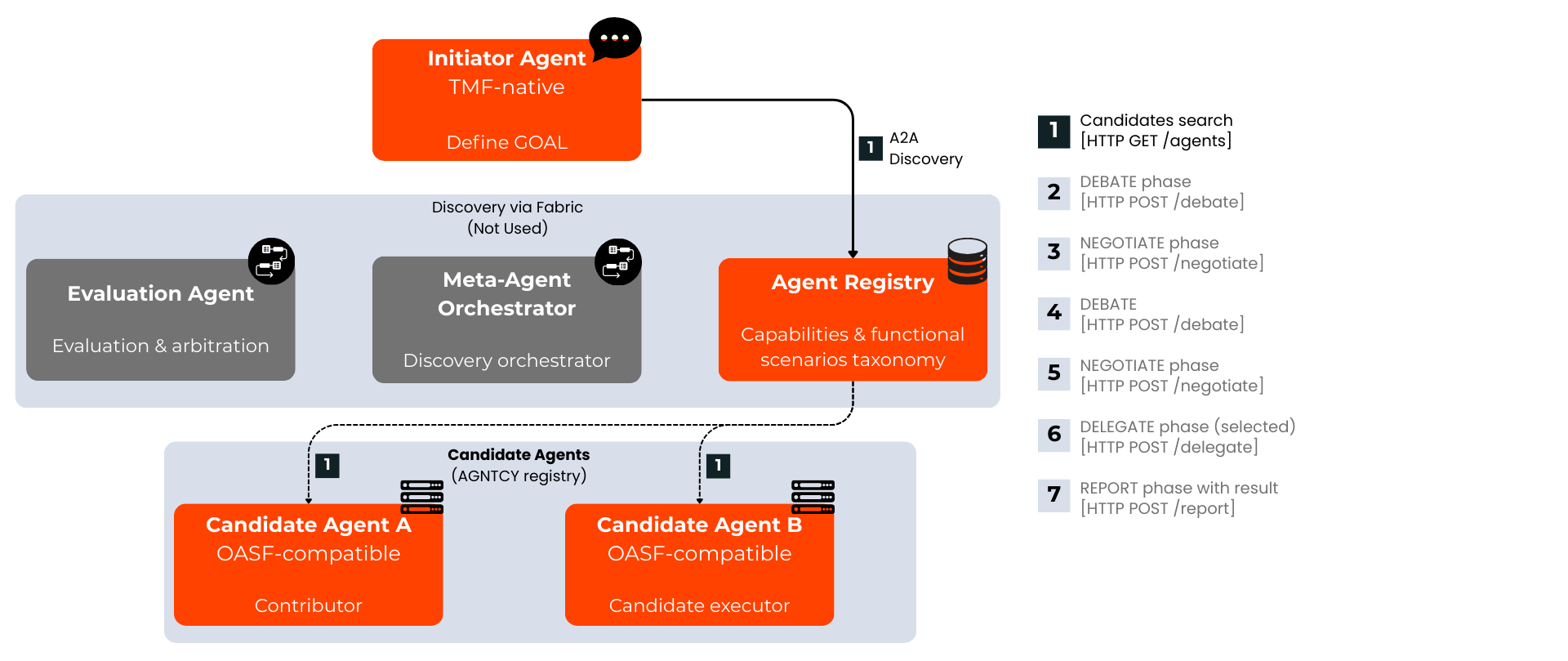
These execution-assisted and hybrid Discovery mechanisms rely on targeted extensions of the TMF939 model that ensure semantic consistency, federated identification, explainability, and improved search quality through the use of capabilityKey, ExternalId, DecisionEvidence, and ExpandedContext:
- capabilityKey Extension
The capabilityKey field serves as a canonical identifier of an agent capability and corresponds to a skill path in the OASF taxonomy, ensuring unambiguous semantic mapping between declared agent capabilities and standardized skills in a global catalog. This eliminates ambiguity and fragmentation in capability descriptions across multi-agent environments. In addition, capabilityKey is used as a foundation for building capability dependency graphs through explicit dependency definitions (depends_on_capabilityKey), enabling automatic composition of capabilities from multiple agents into sequential or hierarchical chains to achieve complex goals.
- ExternalId Extension
The auxiliary ExternalId field is defined according to the ExternalId.schema.json specification and is used to store identifiers originating from external systems or catalogs, including the identifier owner, entity type, and unique identifier. In the context of Agent Fabric, this field stores references to external agent records or taxonomy elements (such as OASF domains and skills), enabling bidirectional logical mapping between a local TMF939 agent and external catalogs. This enables hybrid Discovery, where MEF.DEV can query both the local agent registry and an external AGNTCY directory, automatically aligning query parameters. For example, deployment.domain or ExternalId of type domain can be mapped to an OASF domain, while capabilityKey or ExternalId of type skill is used to construct skill-based queries to external catalogs.
- DecisionEvidence Extension
In Discovery responses, MEF.DEV optionally includes the DecisionEvidence field, which captures the rationale behind selecting a specific agent or agent composition. It contains structured information about goal alignment, coverage of required capabilities and dependencies, calculated ranking, and additional diagnostic details related to the selection process. This makes Discovery transparent and explainable: automated selection results are accompanied by a formal explanation of decisions, removing the “black box” effect and simplifying validation by users or integrating systems.
- ExpandedContext Extension
The ExpandedContext field allows enriching an agent profile with additional semantic context in the form of keywords or domain-specific terms. This context is not used for attribute-based filtering but is included in semantic search and vector-based matching as an auxiliary signal for ranking mechanisms. The use of ExpandedContext improves the completeness and accuracy of semantic matching, which is particularly important for specialized or multi-profile agents with broad capability sets.
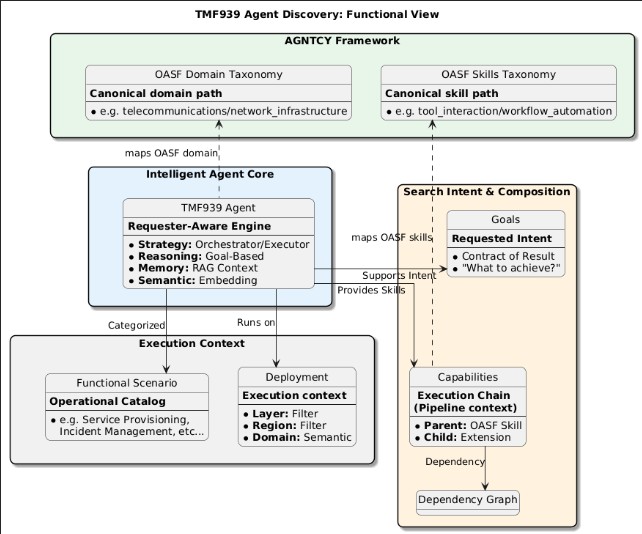
Support for A2A-oriented Discovery enables goal-driven agent composition, where the platform automatically organizes goal achievement by decomposing it into sub-goals, coordinating suitable agents, and selecting a composition that collectively covers all required capabilities. At the same time, the TMF939 standard itself remains unchanged: all additional capabilities are implemented through model extensions and internal platform logic. For the Discovery consumer, this preserves a single, integrated experience—clients submit a simple request via a standard interface (for example, POST /findAgents) with a task description and filters, while the platform automatically determines the appropriate search strategy, combining local selection, semantic ranking, and, when required, agent-to-agent interaction.
Overall, the MEF.DEV extensions directly address previously identified Discovery limitations by unifying attribute-based filtering and semantic search within a single API, providing explainability through DecisionEvidence, introducing a standard-compatible skill taxonomy for unambiguous capability matching (capabilityKey, ExternalId), and enabling dynamic multi-agent composition for complex goals through an interactive A2A-based approach.
Advantages and Limitations of the MEF.DEV Approach in the TMF939 Context
Strengths
The MEF.DEV approach preserves full compatibility with the TMF939 standard while significantly lowering the adoption barrier for advanced Discovery mechanisms in operator environments. This is achieved through the following characteristics:
- Discovery out of the box. The platform provides ready-to-use mechanisms for agent search, semantic matching, and selection without requiring the implementation of complex Discovery logic or specialized coordinator agents by integrators.
- Goal-oriented search. Discovery focuses on achieving a defined goal rather than static attribute matching, enabling identification of optimal executors or agent compositions aligned with expected outcomes.
- Compositional Discovery. The platform supports discovering not only individual agents but also agent compositions that collectively satisfy request requirements, without manual dependency modeling or workflow design.
- Explainable Discovery results. The DecisionEvidence mechanism provides formal explanations of agent selection, goals considered, and capability coverage, removing the “black box” effect of automated selection.
- Non-disruptive TMF939 extension. All Discovery enhancements are implemented as compatible extensions without changing the base TMF939 contract, allowing extended Discovery to be applied to existing agents without modification.
- Optional semantic federation. The Discovery architecture allows optional integration with global taxonomies and external catalogs (such as OASF/AGNTCY), enabling search beyond the local registry when required, without introducing mandatory external dependencies.
Risks and Limitations
Despite its advanced Discovery capabilities, the proposed approach introduces several technical and organizational considerations that should be taken into account during adoption and scaling:
- Additional integration and infrastructure overhead. Advanced Discovery mechanisms, including semantic matching and interactive modes, require additional platform-level components, increasing operational and computational overhead compared to basic catalog-based search.
- Dependence on quality of agent descriptions. Discovery effectiveness depends on disciplined and consistent capability descriptions; agent owners must accurately classify skills and attributes using capabilityKey and ExternalId.
- Dependence on taxonomies and industry coordination. Predictable Discovery results rely on the completeness and currency of shared taxonomies (such as OASF), requiring ongoing maintenance, alignment across organizations, and active coordination within the TM Forum community to converge on common Discovery extensions and future standardization.
Useful Resources:
- Execution-Assisted Discovery Demo (https://youtu.be/Y5FoYn7-oLU)
- MEF.DEV Agent Fabric Discovery: Introduction for Engineers (https://platform.mef.dev/maf/agent_fabric_overview.md)