The TM Forum Catalyst Agent Fabric: A2A-T Runtime, Phase III was presented at TM Forum Digital Transformation World Ignite in Copenhagen in June and received the award Winner — Outstanding Catalyst, AI & automation. Operators do not let agents of different vendors act in production networks until each action can be bound to the operator’s process and proven. The Catalyst addressed this through five capabilities: protocol, semantics, cooperation across vendors, governance, and proof. MEF.DEV contributed to two of them — binding agents to the operator’s process and per-call evidence of it — with its Trusted Gateway component. In the Catalyst materials the component carries the name Trusted Data Gateway, kept from Phase I. In Phase III it gained two parts, specified as profiles of the IG1453 family: the BPMN to A2A-T Mapping Profile (IG1453B) and Trusted Flow, the runtime contract of the Trusted Layer profile (IG1453C).
Situation: the operator’s process was documentation, not a contract
In Phase II the Trusted Gateway governed the data that agents exchange, not the actions they take.
- Each vendor implements processes within its own solution. A process that spans the solutions of several vendors lies outside each of them: it is the operator’s process and the operator’s problem. The operator’s BPMN model described such a procedure but did not bind any agent to it.
- Audit was reconstructed from separate vendor logs. No identifier of a process step survived from end to end across the fabric, while regulation such as the EU AI Act and ISO/IEC 42001 expects evidence per decision.
- Mutual TLS and onboarding proved who an agent was, not what it was authorised to do on a specific call. Without that proof operators do not trust agents to act in production networks. The Catalyst was to deliver a reference architecture that operators could adopt.
Task: make the operator’s process a binding contract, without making the platform an orchestrator or a BPMN engine
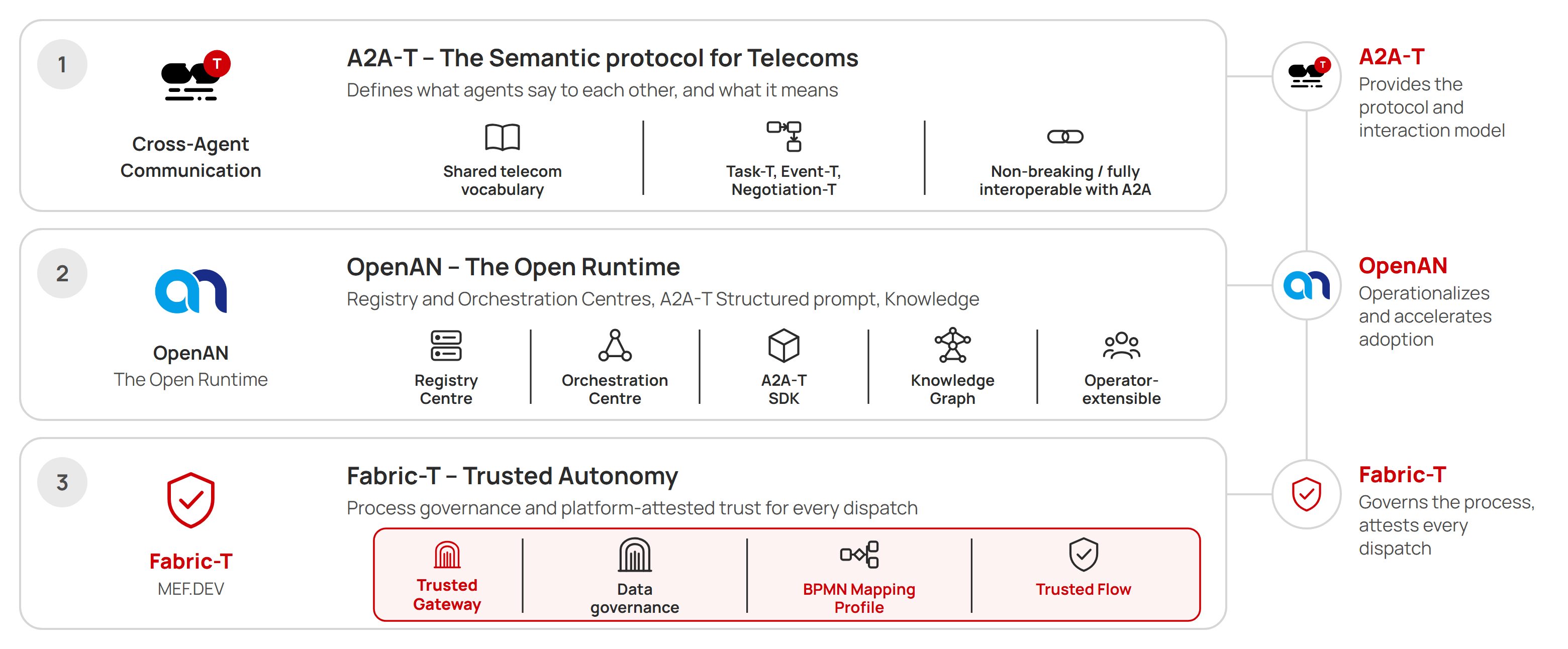
The task was to bind multi-vendor agents to the operator’s own process and to prove, call by call, that they stayed within it. The base of the architecture was the A2A-T protocol (IG1453) and the Structured Prompt syntax (IG1453A); the work was to combine them in the Catalyst architecture. Both new parts of the Trusted Gateway serve this: the BPMN Mapping Profile derives from the operator’s BPMN a Structured Prompt for each activity and the execution rules of the process; Trusted Flow enforces those rules on each call. The MEF.DEV platform, the reference implementation of the Trusted Layer, neither executes BPMN nor orchestrates agents: each agent orchestrates its own part of the process and decides when to act.
The open runtime OpenAN, proposed by the founders of the project, provides the registries, the Orchestration Centre and the Knowledge Graph; the agents of the participating vendors, the Governance Agent, agent evaluation and explainability come from the wider Catalyst team. The Trusted Gateway uses them: the Structured Prompt templates and the execution rules are published to the Knowledge Graph, every Task-T dispatch carries a Structured Prompt in its body, and the audit records are read by the Governance Agent.
Action 1: BPMN Mapping Profile of the Trusted Gateway — Structured Prompt and execution rules from the operator’s BPMN
At the level of an activity, IG1453B compiles a Structured Prompt.
- Each BPMN activity becomes a Structured Prompt template in the IG1453A fields, pinned to a version and classified by an eTOM Level-3 or Level-4 process identifier.
- The compilation is deterministic and uses no language model: the same activity yields the same template on every run.
- The purpose is to remove the entry barrier for A2A agents moving to A2A-T, which carries a Structured Prompt rather than natural language. An agent native to A2A-T assembles the Structured Prompt itself; another agent may use the optional compile service of the platform. The contract on the wire is identical either way.
At the level of the process, the profile defines the rules by which the process is executed.
- The Process Path Graph is an agent-neutral table of edges. Each transition has a stable identifier, its source and target lanes and the evidence the next activity requires; the graph carries its eTOM domain.
- The playbook of the process contains one participation file per BPMN lane, that is per agent, with the agent roster, governance, delegation rules, conditions for handing over to a person, and escalation.
- An edge inside a lane may be free for the agent to reorder or merge; an edge between lanes is always managed and authorised call by call.
- Evidence is typed by its BPMN element: evidence bound to the dispatch token (data store references) gates the next dispatch; pass-through data (data object references) only informs it.
The templates and the rules are published to the Knowledge Graph, and each agent reads its own participation file through Model Context Protocol tools. A change to the process is made in the operator’s BPMN, not in the code of a vendor.
Action 2: Trusted Flow of the Trusted Gateway — the execution rules enforced on each dispatch
Trusted Flow is the runtime contract of IG1453C, carried as opt-in extensions of A2A that leave the base protocol unchanged.
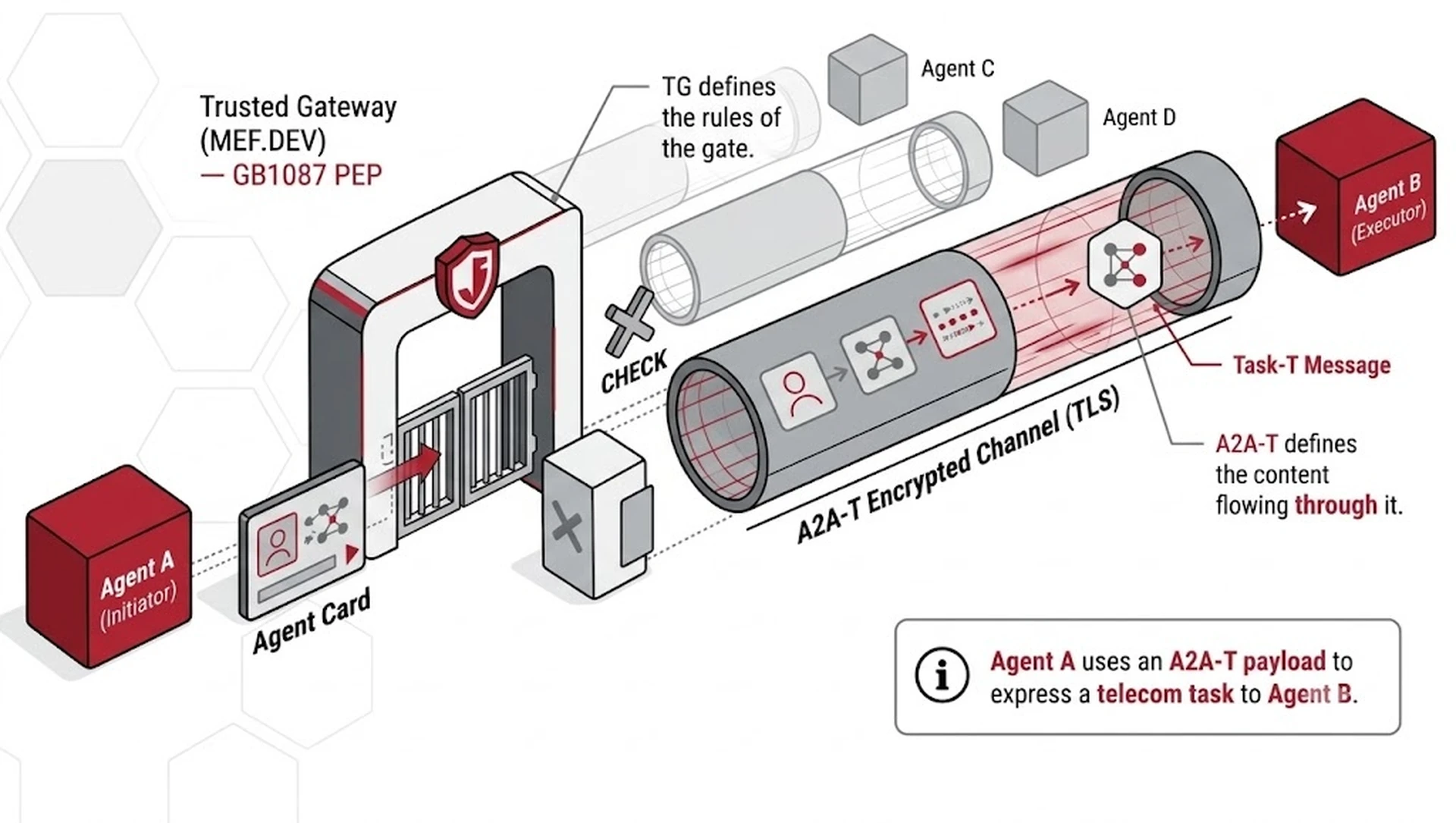
- Before a dispatch, the agent makes one call to the Trusted Gateway. It returns a detached JSON Web Signature over the canonical request body, bound to the caller, the callee, the graph edge and the Structured Prompt template with its version, together with a SecurePassport — a platform-issued envelope of verified context and accumulated evidence. The platform issues every claim; no agent declares its own.
- The SecurePassport carries the state of the process. Before signing, the gateway checks the accumulated evidence against the rules of the chosen edge; the SecurePassport is validated again when an agent presents it. Missing or stale evidence means no authorisation: the evidence chain, not the agent’s identity at the perimeter, is the unit of trust. A human approval in the process is evidence of this kind.
- Synchronous Task-T calls and asynchronous Event-T publications are authorised in the same way.
- Signing, verification and execution each produce an audit event with shared correlation keys, so a call can be traced to the step of the operator’s process with one query.
Result
The Catalyst covered three Autonomous Networks High-Value Scenarios. The documentation of the Trusted Gateway maps the BPMN model of each of them under the BPMN Mapping Profile and authorises its calls under Trusted Flow, with no change to either part:
- Cross-domain service fault management (Assurance): root cause analysis against a digital twin, customer and service impact, prioritisation and routing, complaint handling with a recommended fix, remediation across the transport, core and radio access domains, and confirmation that the service is restored.
- Enterprise service complaint handling and service activation (Service Management & Operations): validation of the customer’s services, root cause and coordination with the transport network domain, resolution with an external agent; activation with identity verification, billing update, wholesale activation and optimisation of the transport network.
- Enterprise fibre-to-the-premises connection (Fulfillment): wholesale fibre, internal fibre and microwave link delivered as three tracks, a field visit for the last mile, and validation of the assembled service.
The Catalyst presentation gives the following improvements for these scenarios. They are target values based on comparable production deployments, not measurements of the Catalyst, and they concern the Catalyst team as a whole rather than the Trusted Gateway.
- Fault management: Autonomous Networks level from Level 3 to Level 4; mean time to repair from more than three hours to less than one hour; operations staffing effort 60–70 % lower; fault demarcation from 70 % to 90 %.
- Complaint handling: from complaint to service credit in one agent process, without intermediate tickets; SLA validation in real time; credit issued by agents within rules set by the operator; coordination across organisations over A2A-T.
- Enterprise connection: fulfilment time from weeks to hours; service activation by agents within the operator’s process; integration of third parties over A2A-T; lower multi-party cost.
Agents chose the next step only among the edges of the Process Path Graph, and each call between lanes carried a platform signature.
Both parts are among the Catalyst’s contributions to the IG1453 family: the BPMN to A2A-T Mapping Profile, version 2.2.0, and the Trusted Layer profile, version 1.2.1. Together they counter threats to agentic fabrics structurally: objective manipulation, through templates pinned at signing; prompt injection, whose effect is limited to the edges the playbook allows; privilege compromise, through claims issued only by the platform; and coordinated multi-agent attacks, through evidence validated per edge.
Limits and next steps
The Trusted Layer carries consent; it does not define who may approve an action. That remains operator governance above the fabric, exercised through the operator’s own BPMN models and their eTOM mapping. Enforcement reaches as far as a verifier is placed in the path of a call: inside the fabric, or in a sidecar in front of an external agent. The next step is containment as well as observation: checkpoints in the SecurePassport that allow rollback to the last valid dispatch, aligned with TM Forum IG1548 Intervention and Control.
The Trusted Gateway and both parts are documented for the reference implementation on the MEF.DEV platform: BPMN Mapping, Process Path Graph and Prompts, Trusted Layer and Human in the Loop: Consent and Delegation. The Catalyst team is listed on the TM Forum project page; the Catalyst is summarised on its evidence page.
The Agent Fabric-T Trusted Layer demo shows the gateway authorising and recording a call: watch the demo or book a call.