The rapid rise of Generative AI is becoming a precursor to the Fifth Industrial Revolution, where intelligent systems work together with humans instead of replacing them – even if this seems counter-intuitive at first. For years, telecom operators have tried to move from fragmented digitalization with different maturity levels toward a fully digital business model. However, real-world digital transformation results still show a significant gap between operators’ expectations and their actual operational performance, as illustrated in reports from KPMG (“From Telco to Techco”) and McKinsey (“The Future of Telcos”, “Scaling the AI-Native Telco”). This is one reason why leading CSPs are increasingly focusing on ecosystems of autonomous agents that can manage networks, optimize loads, make operational decisions, and interact with customers in real time.
Operators usually start their transformation in areas where fast results can be achieved and operational KPIs improved. This pushes them toward architectures where autonomous AI-agents gradually take over more tasks previously handled by humans. As a result, operators begin mixing different sources of operational data with outputs generated by AI agents, creating new layers of contextual information. In such environments, it becomes harder to distinguish original data from AI-generated content.
This shift has multiple dimensions. Some agents (co-pilots) interact directly with customers and provide live assistance. Others are fully autonomous operational agents that constantly process large volumes of technical data, monitor service quality, optimize network resources, or resolve incidents. In the “desired future architecture”, these agents run in the background, orchestrating workflows, adjusting network configurations, and coordinating service assurance.
Together, these systems form an agent fabric – a distributed environment where customer-facing and operational agents collaborate across domains, partners, and platforms. For operators, this architecture helps reduce operational costs and improve financial results, which is increasingly important in annual reports submitted to investors.
Operational benefits – and the new risks
While multi-agent systems provide clear benefits, they also introduce risks. Uncontrolled access to information inside an agent fabric can lead to exposure of private or sensitive data. It can even distort operational truth because AI-generated responses silently enrich the operator’s knowledge base with synthetic or transformed information. Multi-agent systems exchange data through various interfaces whose number and complexity constantly grow. This creates a new reality: information moves faster than traditional governance mechanisms can control. To support such interactions safely, operators need governance tools that operate in real time and track data throughout its lifecycle.
A possible solution is a new architectural component – the Trusted Data Gateway (TDG). A prototype of TDG was developed and demonstrated in the award-winning Catalyst project “Agent Fabric, Phase 2” The TDG is designed to provide automated, real-time governance across agent-based ecosystems, ensuring that data exchanged between agents from different domains or vendors always complies with the operator’s rules and policies.
The Complexity of Agent-to-Agent Data Exchange
Legacy telecom systems were never designed for agents that use natural-language prompts or process unstructured customer data. Popular protocols such as the Model Context Protocol (MCP) often receive confidential data directly from customers – intentionally or not – while the Agent Communication Protocol (ACP) works with deep operational context of the network and services. The need to convert and align these data flows, combined with the absence of a unified integration standard, creates a high risk of unpredictable data exposure, especially in multi-vendor environments.
For example, a government administrator using a dedicated data channel may ask a self-care co-pilot connected to the operator’s MCP server how to change the current router password or adjust configuration settings. For a human, this is a simple request, but a generative AI system attempting to produce an enhanced, step-by-step answer may expect the user to provide the current or new password. During background processing, the MCP-agent might pass this context to an ACP-agent – for intent analysis or automated execution – and this information can end up in logs or technical reports accessible to operator subcontractors.
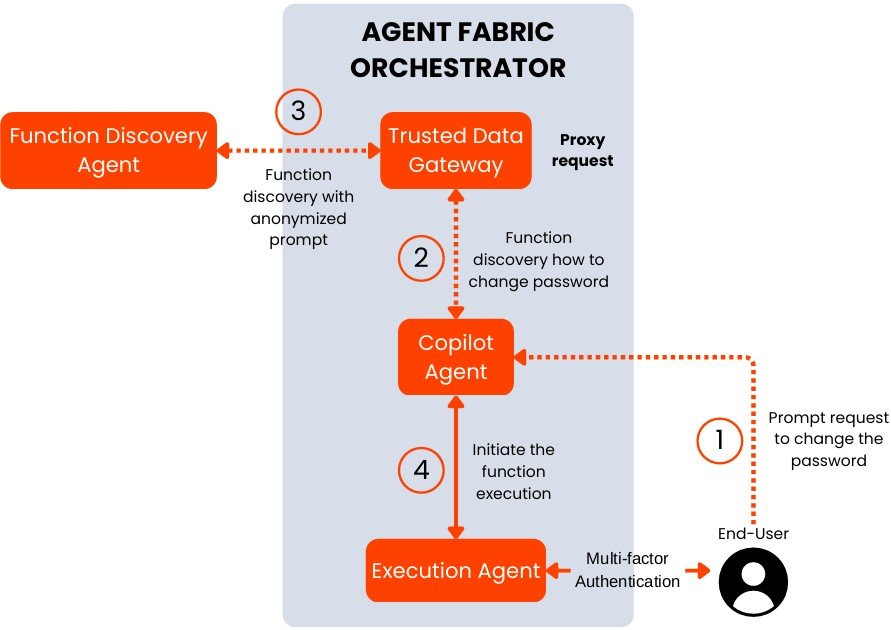
On the other hand, an ACP-agent creating instructions for password reset may unintentionally expose internal technical details – service IP addresses, identifiers, or network configuration attributes – which should never be visible to MCP-agents or external systems.
The challenge is not only confidentiality but also scalability. Even a small agent fabric with three operational agents – for example, radio, transport, and service assurance – creates three possible interaction combinations. Adding a fourth agent increases this number to six, and a fifth agent increases it to ten. According to the classical combinatorial rule N(N-1)/2, the number of potential interactions grows with the square of the number of agents. Practically, each new agent introduces more data exchanges, more contextual transitions, and more correlation scenarios, making manual oversight impossible. Operators need a mechanism that understands what data is being exchanged, why, and who is allowed to receive it – without slowing down automation.
Adaptive Trust and Policy Governance
The TDG addresses these challenges by using a Transparent Service Layer approach: governance is provided as a runtime service, implemented as a Policy Enforcement Point (PEP) that transparently applies policies to every interaction session between agents. The TDG evaluates every request, response, and system message, applies policies automatically in real time, and performs several key functions shown in the Catalyst demonstration:
- validating agent identity and ensuring MCP, ACP, and multi-vendor agents operate within allowed policy scopes;
- classifying data and agent context to detect personal, operational, or regulated attributes (MSISDN, IP address, password, username, email, etc.);
- binding policies to data objects to enforce controlled access during cross-domain and cross-vendor exchange;
- removing, masking, or anonymizing sensitive information while preserving user intent;
- generating audit records for regulatory, operational, and compliance purposes.
Static integrations or out-of-the-box PEP components are not suitable for agent fabrics because agent environments evolve continuously, and their sensitivity is high. As more capabilities are added to the architecture, incompatibilities and risks grow. A single misconfigured agent call, unexpected data exchange, or accidental context leak can cause major violations of personal-data protection rules or expose sensitive operational knowledge. Manual checks or classic test-case-based testing do not scale.
The TDG must reduce these risks by enforcing a zero-trust model and applying adaptive, continuously improving policies for every agent interaction – including analysis of real data requests. This gives agents the freedom to collaborate and evolve in an Agile manner without adding new attack surfaces, vulnerabilities, or compliance issues, even in multi-vendor environments.
TDG as Part of Security Governance in ODA
All these aspects require standardization of agent fabrics and a clear definition of one of their core functions – adaptive trust and policy governance, delivered through the Trusted Data Gateway. Within the Open Digital Architecture (ODA), the TDG logically fits into the Security Governance area. Its architecture relies on TM Forum’s standard APIs – including those used in the “Agent Fabric, Phase 2” Catalyst: Agents Management API (TMF939) and Copilots API (TMF785). TDG also incorporates results from earlier TM Forum initiatives: Data Sharing Agreement (TMF732A), Management Information API Suite (TMF729A), and the Security Annotation Extensions (SID Management Info Extension). These define how agents request data, how TDG evaluates policies, and how governance decisions are enforced. Real implementations can extend the baseline models and specify:
- how data is classified and labeled on ingestion;
- how policies are attached to data objects;
- how trust levels and agent identities are evaluated;
- how policies are applied in real time;
- how audit records are generated and stored.
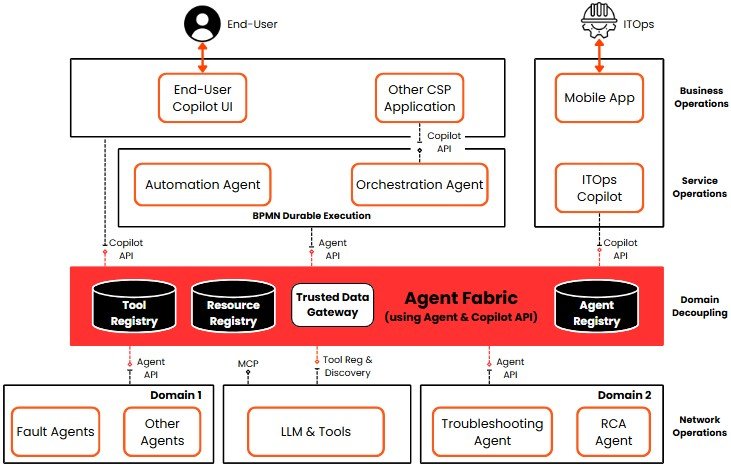
Standardised interfaces ensure that MCP, ACP, and external vendor agents interact with governance mechanisms consistently. This consistency enables TDG to function reliably in multi-vendor ecosystems and scale along with the growth of agent fabrics.